ID Bot Automation System — AI Pipeline for Instructional Design
Independent Project | Claude AI · n8n · Google Docs API · Tally · Netlify | March 2026
What This Project Is
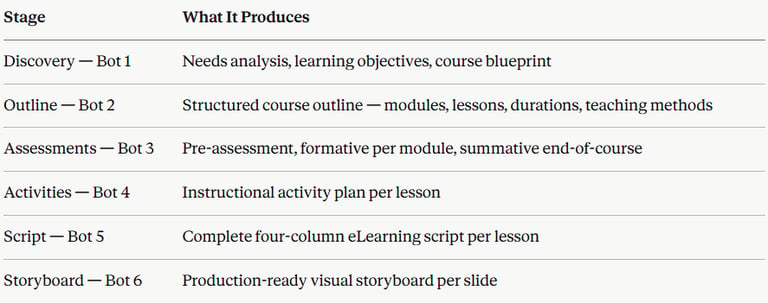
The ID Bot Automation System is a six-stage AI pipeline that takes a course brief from a client and produces a complete, design-ready instructional package — automatically. Each bot handles one stage of the instructional design process. The output of every stage feeds the next.
The vision: a subscription SaaS product for instructional designers and L&D teams — where a client submits a single intake form and receives a fully structured, production-ready course package in minutes instead of weeks

The ID Thinking Behind the System
This is not a content generator. It is an instructional design system — built on the principle that AI should do the silent analytical work that takes an ID hours, while the human designer retains judgment and approval at every stage.
Every design decision in the pipeline is derived from instructional theory:
Bloom's Taxonomy — silently applied to determine cognitive level per objective based on course category
Backward Design — assessments designed before activities; every activity prepares learners for the specific assessment already approved
ADDIE alignment — Discovery → Outline → Assessments → Activities → Script → Storyboard maps directly to Analysis → Design → Development
Kirkpatrick Levels — silently mapped per category — Level 1+2 for compliance, Level 3+4 for performance gap courses
ABCD Method — applied for compliance and knowledge transfer courses
How It Was Built
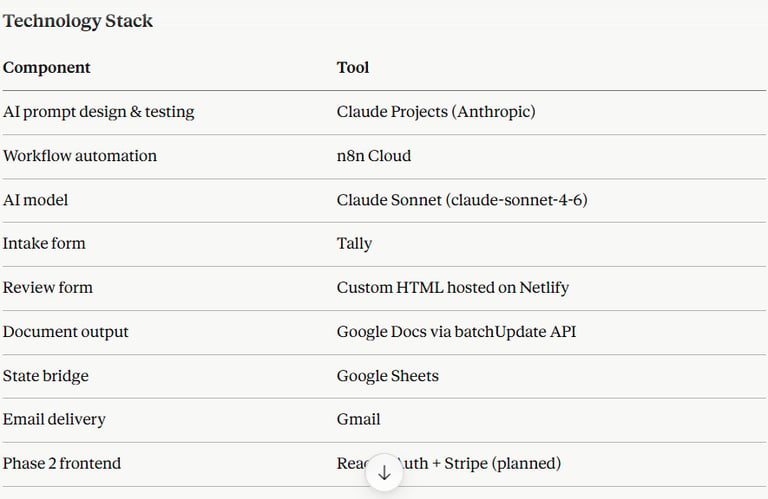
Phase 1 — System Prompt Design in Claude Projects
All six bot system prompts were fully designed, written, and tested inside Claude Projects — Anthropic's AI environment for building persistent, instruction-following AI agents. Each system prompt was refined across multiple real-world case studies — including ConnectNow Telecom, Nova Payments, SafeWork Industries, Meridian Consulting, Apex Financial, and BrightPath HR — before any automation was built.
This phase required encoding complete instructional design theory into AI behaviour — every rule, every edge case, every output format specified precisely so the bot produces consistent, pedagogically sound output without human intervention at each step.
Phase 2 — n8n Automation Build
Once system prompts were validated, automation was built in n8n — connecting the AI outputs to real-world delivery infrastructure.
Bot 1 — Discovery (Fully Operational in n8n)
Bot 1 is the only fully built, tested, and operational automation in the pipeline. It receives structured data from a Tally intake form — no questions asked in the chat interface. It silently applies instructional theory and generates a three-section Discovery Summary:
Section 1 — Needs Analysis: course topic, category, problem statement, goals and gaps, instructional theory, learner profile, course parameters
Section 2 — Learning Objectives: Bloom's or ABCD method, two versions per objective — designer reference and learner-facing
Section 3 — Course Blueprint: complete summary table of all design decisions
The output is automatically formatted as a Google Doc via batchUpdate API, shared with the client, and delivered via HTML email — with a link to a Netlify-hosted review form where the client approves or requests revisions. A revision handler workflow reads the original prompt from Google Sheets and regenerates the document if needed.
Bot 2 — Course Outline (Fully Operational)
Bot 2 takes the approved Discovery Summary and generates a complete course outline, asking the human reviewer just one question — course title — presented as three to four AI-generated suggestions plus a "write your own" option. Every other design decision, including course approach, module structure, and teaching methods, is made silently, driven entirely by the Discovery output.
Triggered from the same Netlify review form used in Bot 1, reused with a stage parameter for Outline
Context package pulled from Google Sheets by document ID
Title-selection flow delivered via automated email with a review interstitial
Full revision handling loop for outline edits
Bots 3–6 — Prompt Complete, n8n Builds In Progress
All six system prompts are complete and tested. The n8n automation builds for Bots 3–6 are in progress.
Bot 3 (Assessments) — follows Backward Design; maximum two questions
Bot 4 (Activities) — zero questions; purely generative; one activity per lesson
Bot 5 (Script) — complete four-column format; Context Compression Logic prevents tone drift across long courses
Bot 6 (Storyboard) — zero questions; purely transformative; every slide includes layout, narration, visuals, interactions, and accessibility notes

Current Status
✅ Bot 1 — Discovery — Fully operational in n8n — end-to-end tested
✅ Bot 2 — Outline — Fully operational in n8n — end-to-end tested
✅ All 6 system prompts — Complete and tested in Claude Projects across 6 case studies
⏳ Bot 3 — Assessments — n8n build in progress
⏳ Bot 4 — Activities — n8n build in progress
⏳ Bot 5 — Script — n8n build in progress
⏳ Bot 6 — Storyboard — n8n build in progress
What This Project Demonstrates
Most instructional designers use AI as a writing assistant. This project treats AI as an instructional system — with theory, logic, rules, and quality checks built in at every stage.
Building this required simultaneously applying deep instructional design knowledge to encode ID theory into AI behaviour, technical architecture thinking to design a six-bot pipeline with shared state management, and systems thinking to anticipate edge cases, build revision handlers, and ensure output quality across diverse course types.
The pipeline is in active development. Bot 1 is live and operational. The full system will be available as a subscription product for instructional designers and L&D teams.